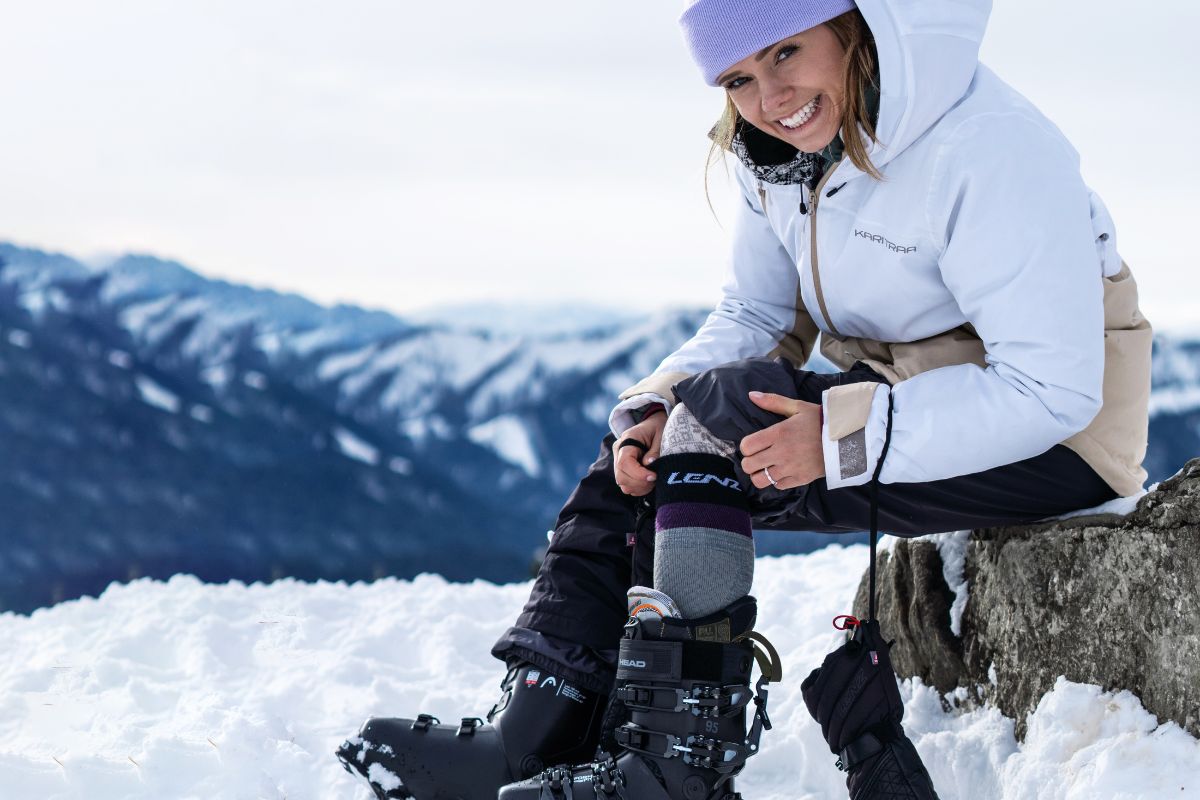
Socks are the cheapest part of your ski kit, but they have a big effect on how your day feels. The wrong pair can leave you with blisters or cold toes by lunchtime. The right pair keeps your feet warm and dry and helps your boots fit the way they should.
This guide covers why ski socks matter, what to look for and how to choose between thin, cushioned and compression styles.
Do you really need ski socks?
Yes. Ski boots are rigid and fit closely, so anything between your foot and the boot matters. Unlike everyday socks, ski socks cushion pressure points and fit without wrinkling. They also manage moisture. Together, that helps prevent blisters, keeps your feet warm and improves control inside your boot.
Ski socks are also knee-high. That matters because the top of a ski boot sits on your shin, and a short sock leaves skin or fabric folds exposed to rubbing.
Why merino wool?
Your feet sweat inside a warm ski boot, even on a cold day. Cotton or Polyester soaks up that sweat and holds it against your skin, and damp feet get cold fast as soon as you stop moving.
Merino wool handles moisture far better. It is breathable and dries quickly, and it stays warm even when damp. It also resists odour naturally, which helps on multi-day trips. Good ski socks blend merino with a little synthetic fibre for durability and stretch.
All of our Lenz ski socks use a high merino content with Lenz's Merino SoftTec® blend, which is soft and scratch-free against the skin.
What to look for
A left and right fit
Lenz ski socks are knitted specifically for the left and right foot. They follow the shape of your foot more closely, so there is less spare fabric to bunch up inside the boot.
Flat toe seams
A thick seam across the toes can rub inside a tight ski boot. Lenz ski socks use a flat, hand-linked toe seam, so you won't feel it.
A sock that stays put
A sock that slides down creates wrinkles, and wrinkles cause blisters. Look for ring bandages around the instep and above the ankle, which hold the sock in place all day, and a soft cuff that won't dig into your calf.
The right amount of padding
This is the biggest choice, and it depends on your boots.
Thin, cushioned or compression?
Cushioned: Skiing 3.0 Merino
The Skiing 3.0 suits most recreational ski and snowboard boots. It has extra-soft padding in the toe, heel and shin, including protection where the boot tongue presses on your shin. Its 67% merino content makes it a warm choice for cold days.
Thin: Skiing 6.0 Merino
The Skiing 6.0 is ultra-thin and feels like a second skin. It suits tight, performance-fit boots and race boots, where a thick sock would squeeze your foot and dull the feel through your boot. It has a merino and silk footbed and light padding in the toe and heel.
It can seem strange that a thin sock can be warmer than a thick one, but in a snug boot it often is. A thick sock squashed into a tight boot restricts circulation, and poor circulation means cold toes.
Compression: Compression Socks 2.0 Merino
The Compression Socks 2.0 use a performance compression knit that promotes circulation and reduces fatigue. That keeps your legs fresher for longer and supports recovery after a big day. Better circulation also helps keep your feet warm, so they are a great choice for multi-day trips.
They are sized by calf circumference at the widest point: S 24–32 cm, M 32–38 cm, L 38–44 cm and XL 44–51 cm.
How to wear ski socks
Wear one pair of ski socks only. Doubling up adds wrinkles and pressure points, and it can make your boot so tight that your feet get colder.
Pull the sock up smoothly so there are no folds at the heel or ankle, then make sure nothing else is tucked into your boot. Thermal leggings and ski pants should sit above the boot cuff, so only the sock is inside.
Put your socks on just before your boots, and keep a dry pair in your bag. If your feet get damp, a fresh pair at lunch makes a big difference for the afternoon.
How many pairs do you need?
You can wear a pair of ski socks for about two days before changing them. For a week-long trip, take three or four pairs so each pair can dry fully between uses.
Still getting cold feet?
If good socks and well-fitted boots still leave you with cold toes, heated ski socks are the next step. Read our guide to choosing heated ski socks to see how they work and how long they last.
Find your pair
Browse our full range of merino ski socks. If you aren't sure which style suits your boots, get in touch and we will help.
Share:
How to layer heated clothing for skiing
Heated gloves or heated mittens: which is warmer?